Analyses for heavy metals, mycotoxins and microbiological purity
Laboratory analyses and quality control
At DR. GOSAR d.o.o., we systematically monitor product quality and safety. When determining the frequency of individual laboratory analyses, we take into account the origin of the raw material, traceability, the production process, drying and storage conditions, and risk assessment.
Why do we not necessarily perform every analysis for every lot?
The hemp biomass we use for extraction comes from the same cultivation area or a controlled source of raw material. After harvesting, the raw material is dried, stored and processed under controlled and comparable conditions, while ensuring traceability of individual batches. Therefore, for certain parameters where the risk does not change significantly between individual lots, we use a sampling plan based on risk assessment and periodic verification, instead of automatically testing every individual lot. This applies primarily to parameters whose presence is largely associated with the origin of the raw material and cultivation conditions, such as heavy metals. For parameters that can be more significantly affected by drying, moisture, storage, hygiene and time, such as microbiological contamination and mycotoxins, we carry out appropriate periodic or additional controls and increase them as necessary according to the assessed risk.
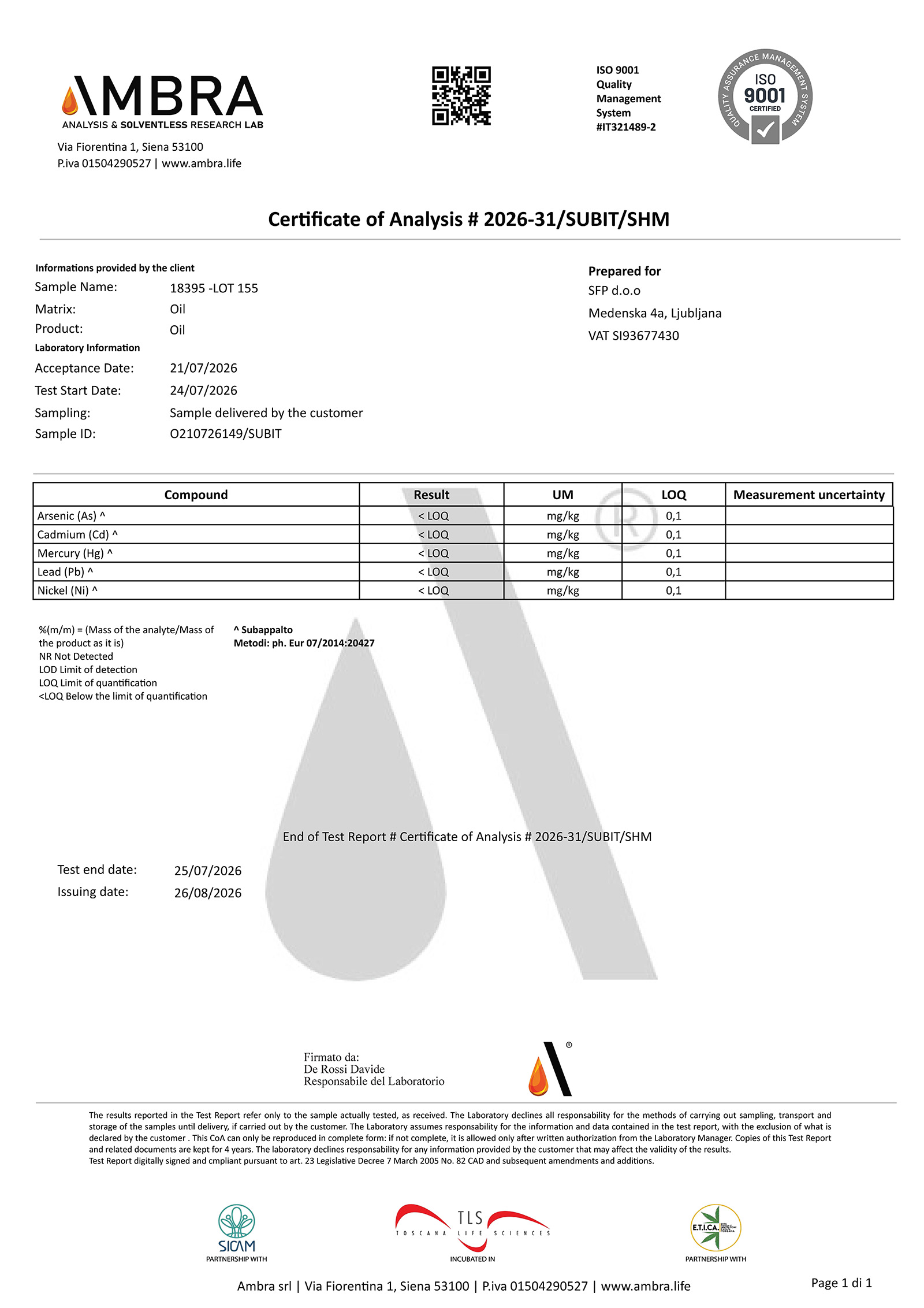
Heavy metals
The presence of heavy metals is primarily associated with the environment in which the plant was grown, particularly the soil and other potential sources of contamination. Because we use raw material from a controlled source and ensure traceability, the frequency of testing can be determined on the basis of a risk assessment.
In the laboratory analysis, the levels of arsenic (As), cadmium (Cd), mercury (Hg), lead (Pb) and nickel (Ni) were below the limit of quantification (< LOQ).
Heavy metals analysis – PDF
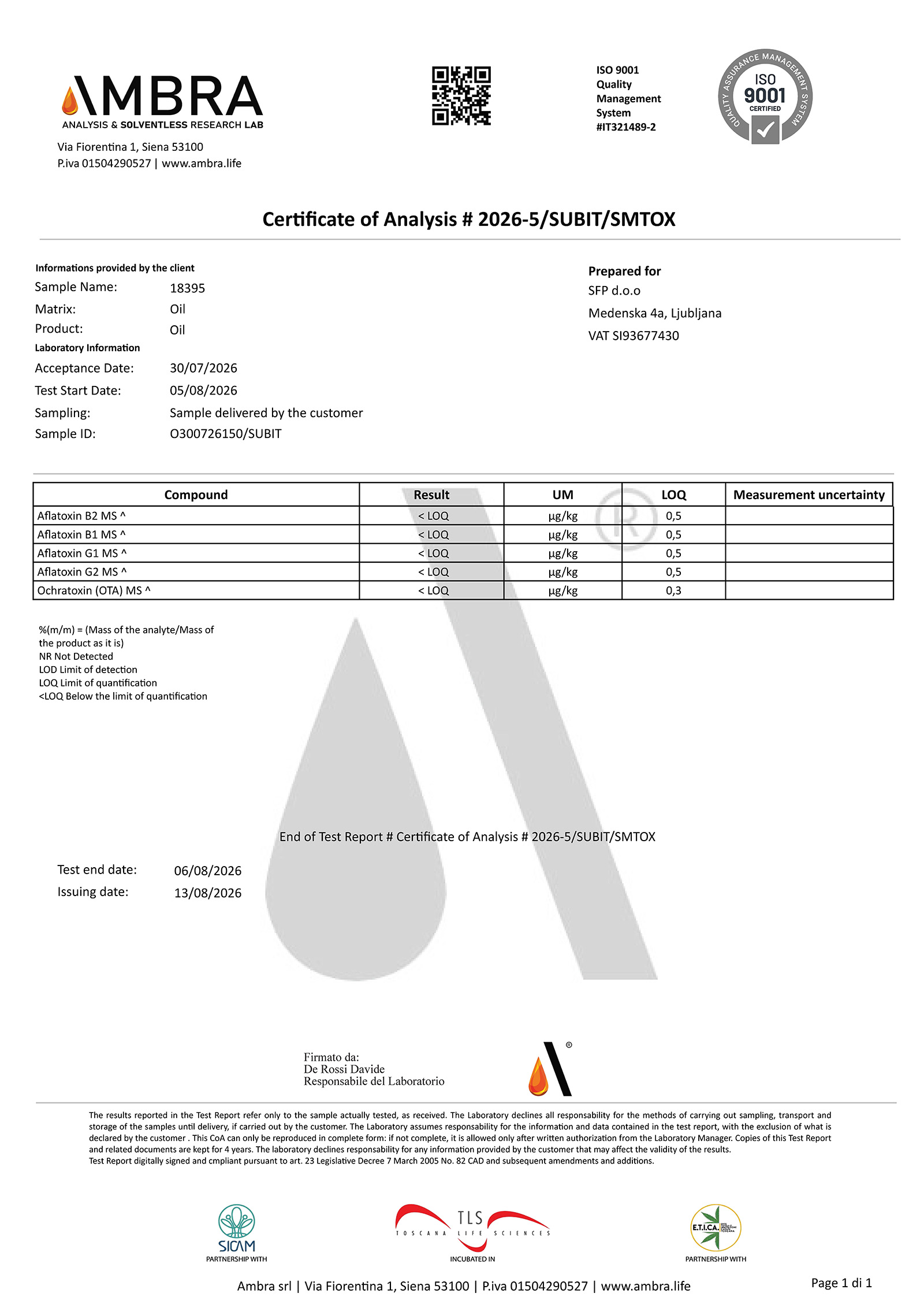
Mycotoxins
Mycotoxins are primarily associated with mould growth and conditions such as moisture, temperature, drying and storage.
In the laboratory analysis performed, aflatoxins B1, B2, G1 and G2 and ochratoxin A (OTA) were below the limit of quantification (< LOQ).
Mycotoxin analysis – PDF
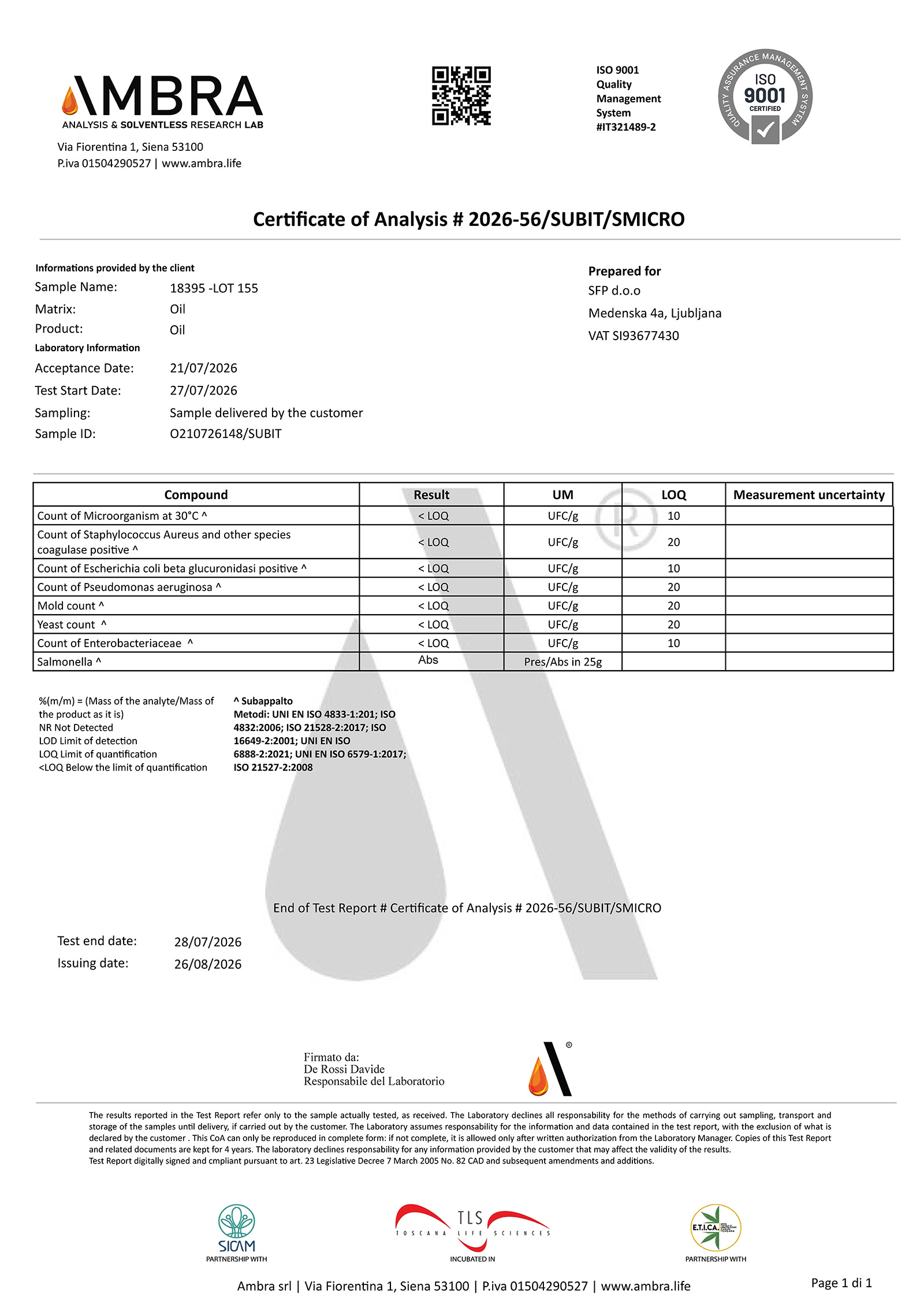
Microbiological quality
Microbiological status can be significantly affected by hygiene, moisture, drying and storage, so we monitor it as part of our quality control system.
In the analysed lot, all quantitatively determined microbiological parameters were below the limit of quantification, and Salmonella was absent in 25 g of the analysed sample.
Microbiological analysis – PDF
Laboratory-tested product
The analyses listed above were performed on 5% ORGANIC CBD drops, 20 ml (1000 mg), batch LOT 155.
5% ORGANIC CBD drops 20 ml (1000 mg) – LOT 155
For this batch, additional laboratory analyses were performed for heavy metals, mycotoxins and microbiological purity.
The product page also includes the results of the cannabinoid content analysis for batch 155.
Our approach to quality control
Our goal is not to perform laboratory analyses merely as a formality, but to establish a meaningful, traceable and risk-based quality control system.
Under stable and traceable production conditions, the frequency of individual analyses is therefore determined according to the risk assessment. If there is a change in the raw material, cultivation area, supplier, drying or storage conditions, or if a deviation is detected, the scope and frequency of analyses may be increased.